OUR LESSON STUDY EXPERIENCE
by paul foster and steve whittle
Introduction
We were completely new to lesson study prior to our visit to Hillgrove Secondary School. We worked in a lesson study group with members of the English Language Department and our introduction to the practices and principles of lesson study was through completing the process from start to finish.
Our lesson study group:
Marcus (observer), Siti (facilitator + observer), Ashley (scribe + observer) and Esther (teacher)
There are five key components to lesson study:
Stage 1: Pre-lesson observation discussion (planning)
Stage 2: Research lesson observation 1 (delivery)
Stage 3: Post lesson observation debrief (reflection + refinement)
Stage 4: Research lesson observation 2 (delivery)
Stage 5: Final Post lesson observation debrief + next steps (reflection)
We were completely new to lesson study prior to our visit to Hillgrove Secondary School. We worked in a lesson study group with members of the English Language Department and our introduction to the practices and principles of lesson study was through completing the process from start to finish.
Our lesson study group:
Marcus (observer), Siti (facilitator + observer), Ashley (scribe + observer) and Esther (teacher)
There are five key components to lesson study:
Stage 1: Pre-lesson observation discussion (planning)
Stage 2: Research lesson observation 1 (delivery)
Stage 3: Post lesson observation debrief (reflection + refinement)
Stage 4: Research lesson observation 2 (delivery)
Stage 5: Final Post lesson observation debrief + next steps (reflection)
STAGE 1: PRE-LESSON OBSERVATION DISCUSSION
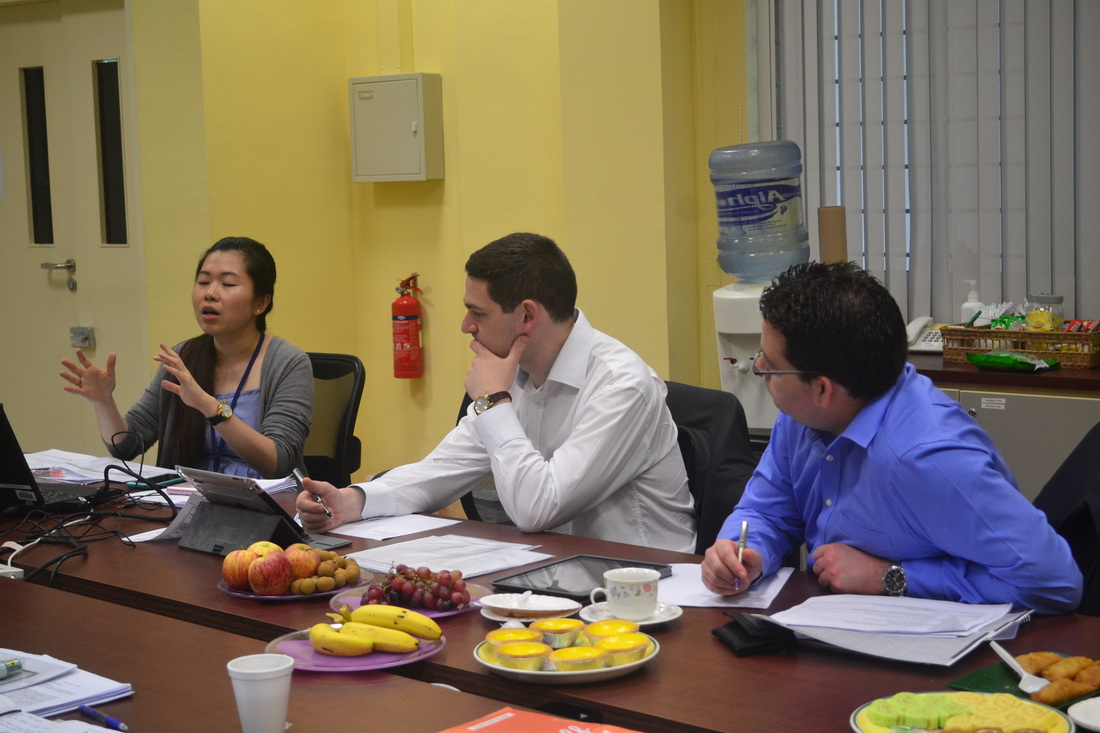
The facilitator (Siti) welcomed all members of the team and thanked Esther (teacher) for opening her classroom while we " lend our eyes" to supporting her in the classroom.
The teacher (Esther) went through the lesson context explaining:
(i) the class profile
(ii) the learning intentions/objectives
(iii) focus for observation
The teacher took all participants of the lesson study group through the lesson plan with participants asking questions for clarification.
The facilitator related back to the learning objectives and led the group through discussion about each phase of the lesson.
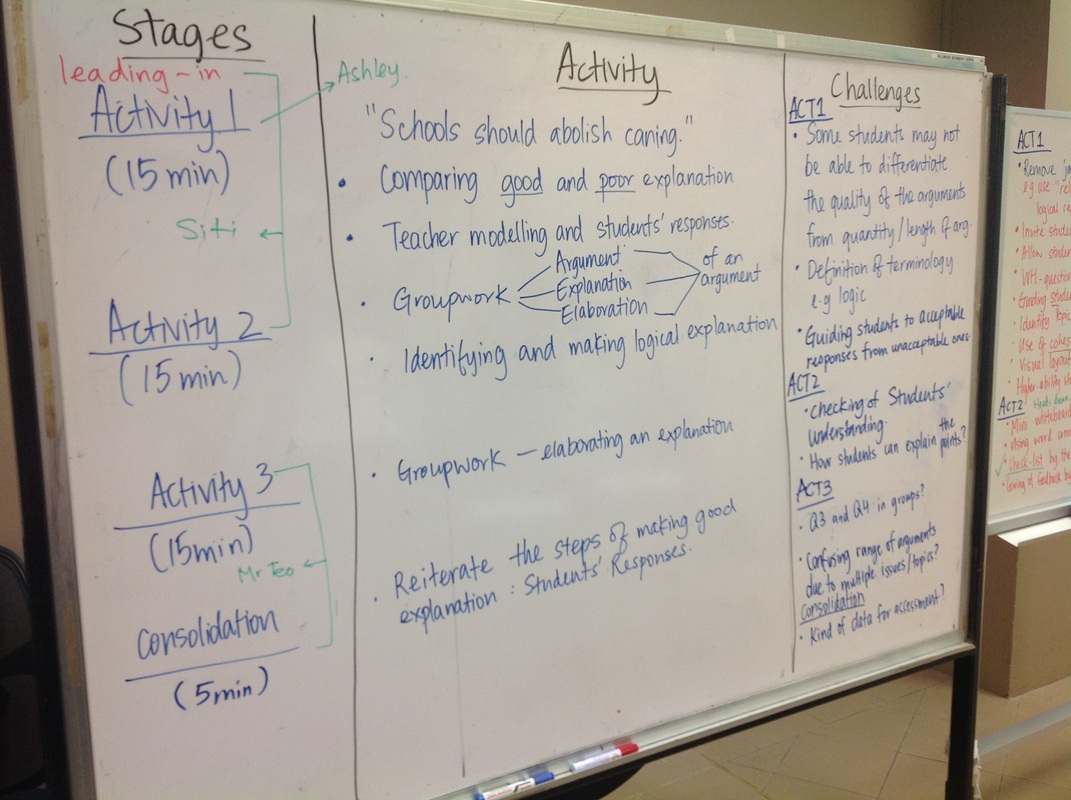
The focus of the discussion for each phase of the lesson (i.e. leading in activity, activity 1 etc.) was:
Stages of lesson
Activity (the nature of the activity)
Challenges
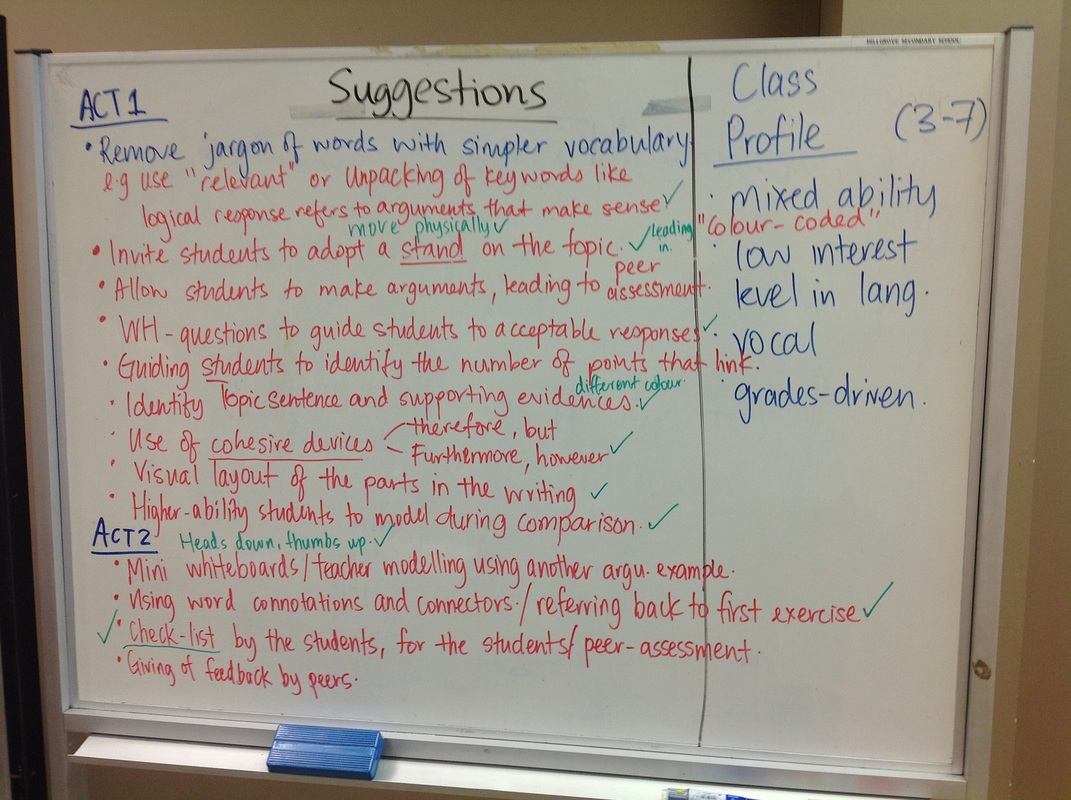
Suggestions
Ashley (scribe) recorded the outcomes of our discussion on whiteboards.
The teacher (Esther) went through the lesson context explaining:
(i) the class profile
(ii) the learning intentions/objectives
(iii) focus for observation
The teacher took all participants of the lesson study group through the lesson plan with participants asking questions for clarification.
The facilitator related back to the learning objectives and led the group through discussion about each phase of the lesson.
The focus of the discussion for each phase of the lesson (i.e. leading in activity, activity 1 etc.) was:
Stages of lesson
Activity (the nature of the activity)
Challenges
Suggestions
Ashley (scribe) recorded the outcomes of our discussion on whiteboards.
|
|
The whole group went through the suggestions and agreed what was to be implemented into the revised lesson plan.
The facilitator delegated which observers would focus on observing specific phases of the lesson and groups of students, including where to be seated geographically within the classroom. The facilitator also recapped and highlighted what observers were to look for e.g. reactions of the students to activities, body language, contributions etc.
Following this meeting the teacher went away to revise and refine the lesson plan and resources in advance of the research lesson the next day.
The facilitator delegated which observers would focus on observing specific phases of the lesson and groups of students, including where to be seated geographically within the classroom. The facilitator also recapped and highlighted what observers were to look for e.g. reactions of the students to activities, body language, contributions etc.
Following this meeting the teacher went away to revise and refine the lesson plan and resources in advance of the research lesson the next day.
STAGE 2: RESEARCH LESSON OBSERVATION 1
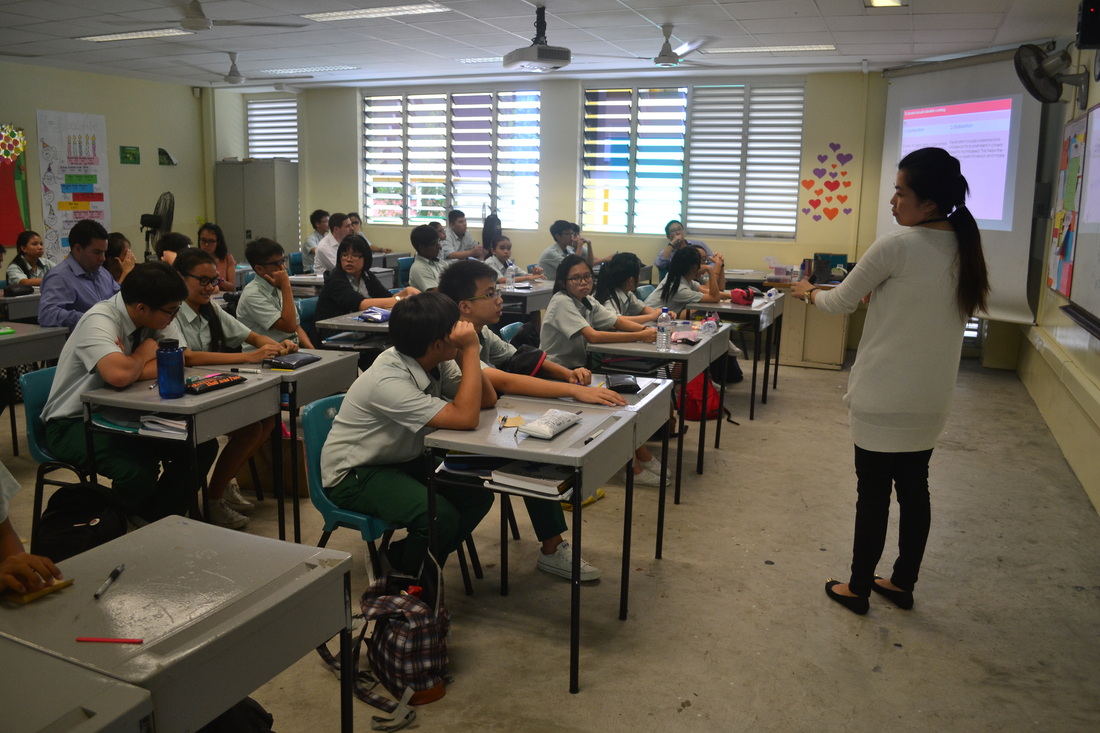
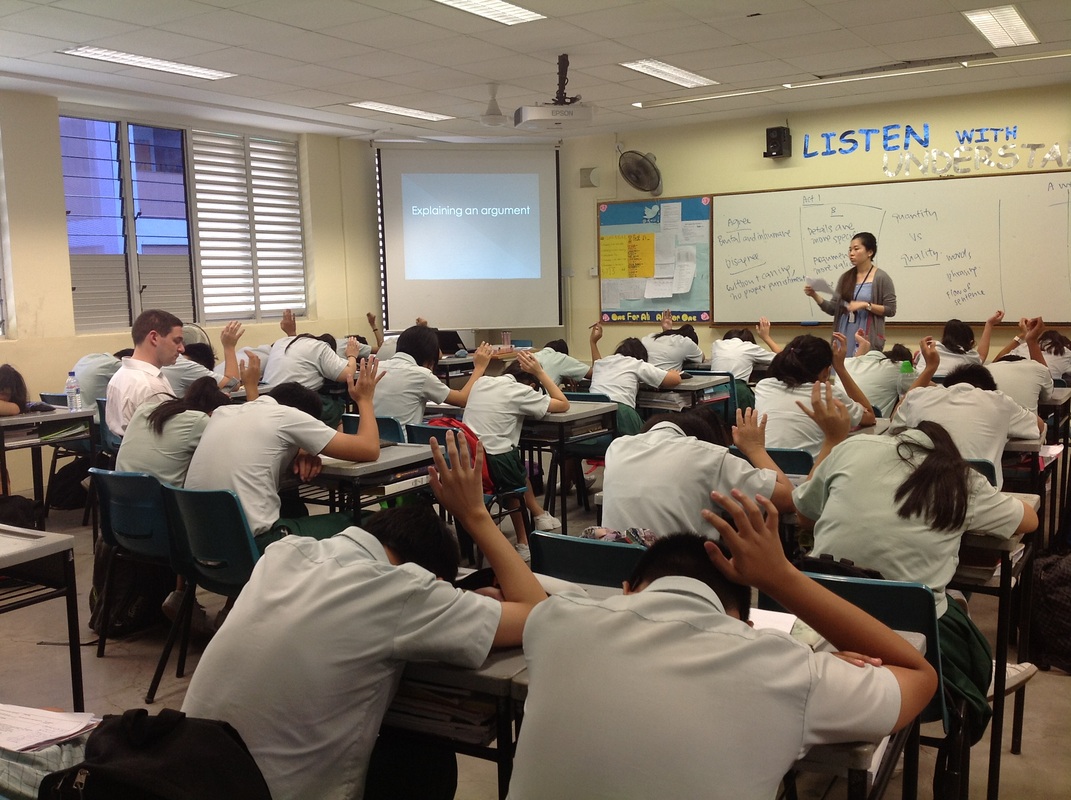
During the lesson observers were situated around the room and focussed on watching groups of students (as agreed) and their engagement with and responses to lesson activities. Observers also individually focussed on making observations about a specific phase/activity in the lesson.
Contrary to common practice in lesson observations in our school, observers did not interact with and speak with students but instead concentrated on listening to and watching students.
A chronological lesson plan proforma was provided for observers which allowed for comments to be made at each point of the lesson.
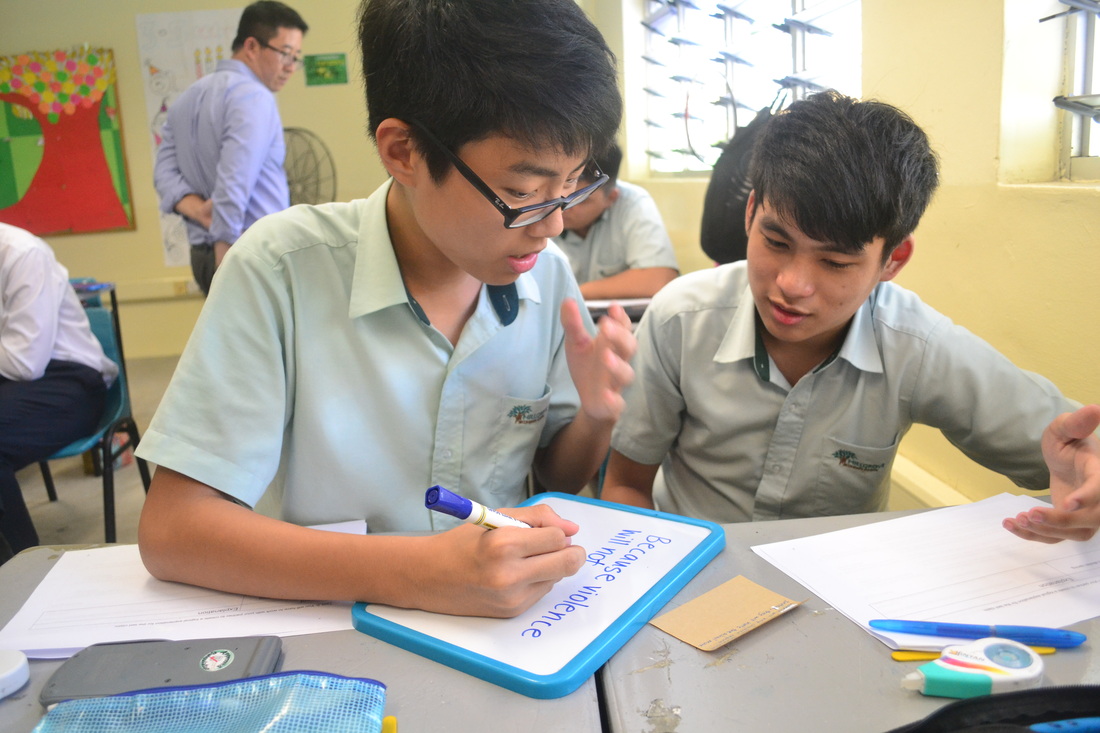
At the end of the lesson observers collected student work (artefacts) for the subsequent post research lesson discussion for the students, whom they had been focussed on observing.
Contrary to common practice in lesson observations in our school, observers did not interact with and speak with students but instead concentrated on listening to and watching students.
A chronological lesson plan proforma was provided for observers which allowed for comments to be made at each point of the lesson.
At the end of the lesson observers collected student work (artefacts) for the subsequent post research lesson discussion for the students, whom they had been focussed on observing.
|
|
|
STAGE 3: POST LESSON OBSERVATION DEBRIEF
The facilitator leading the discussion invited the teacher to
(1) Share what they liked about the lesson (the facilitator asked questions for clarification during this)
(2) Explain anything about the lesson they would like to change
Then the facilitator went around the observers asking for their overview of how the lesson went with specific reference to the students and observations about their response to the lesson. (The focus of the discussion being on students and their learning and engagement made the feedback non-threatening and purely developmental for the teacher observed).
The facilitator outlined and reminded the observers what they were looking for in sharing their observations. These were:
(1) The physical responses of students
(2) The interaction between students (verbal and non-verbal)
(3) Questioning and students' attitudes/responses to questions asked
(4) Student attitudes towards feedback
(5) Students' exploration of learning
(6) Students' demonstration of understanding
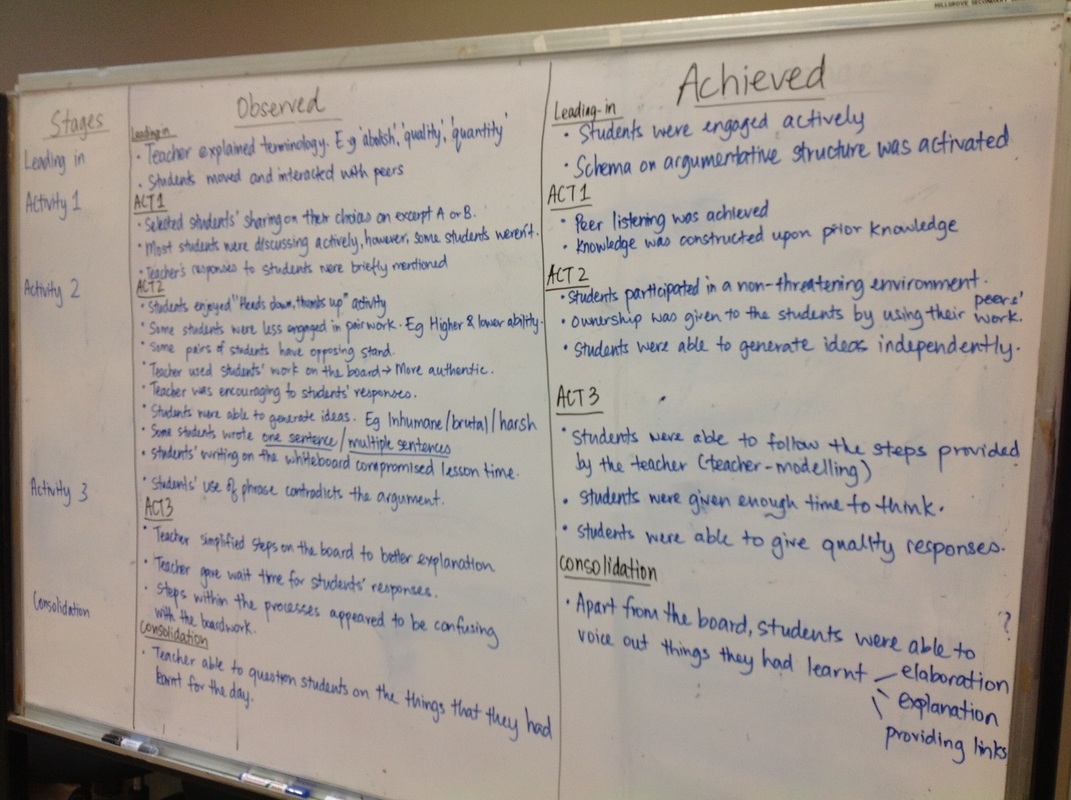
The lesson was gone through section by section with contributions from all observers and the scribe recorded for each phase/activity of the lesson:
(A) Observed
(B) Achieved
(C) Action for improvement
Artefacts (e.g. worksheets, exercise books) were brought to the debrief in order to analyse the exact nature of students' work.
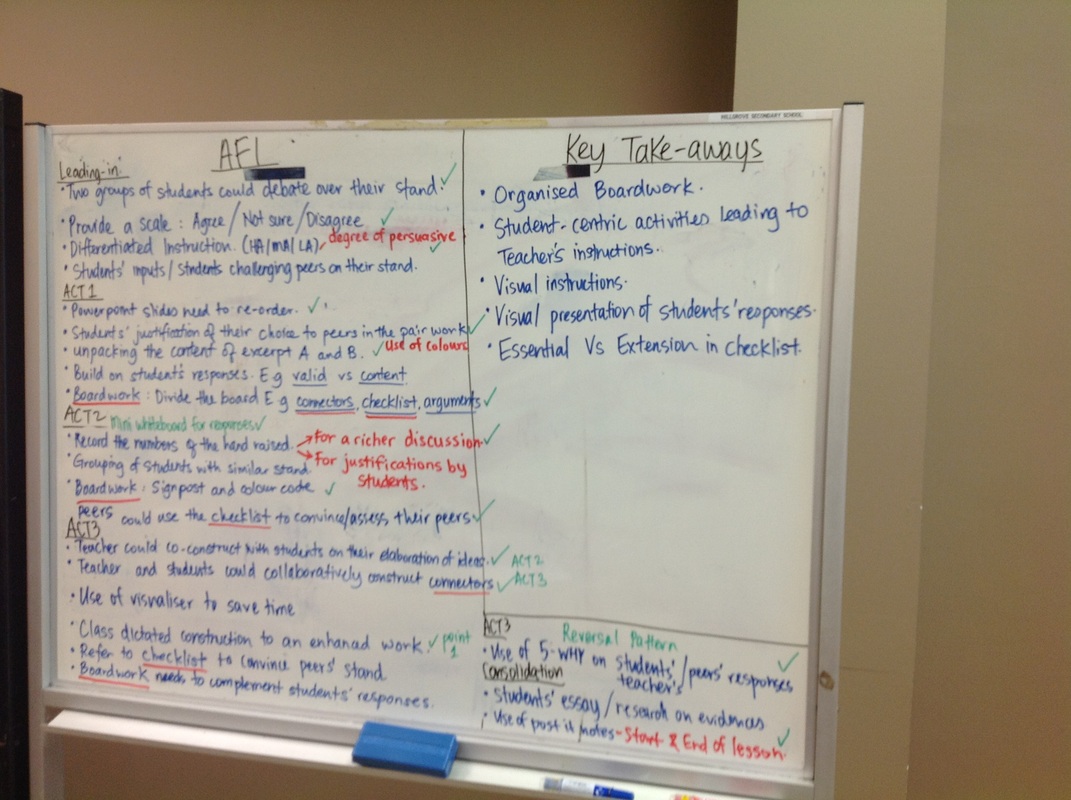
The facilitator then re-capped the overview of the lesson and the group identified "key take-aways" both in terms of the next lesson and wider learning.
Finally, it was agreed how the lesson will be modified and the teacher then asked for consensus on the best way to adapt the lesson i.e. which suggestions from the areas for development column should be implemented and how.
The teacher then went away to redraft and adapt their lesson planning overnight in advance of Research Lesson Observation 2.
(1) Share what they liked about the lesson (the facilitator asked questions for clarification during this)
(2) Explain anything about the lesson they would like to change
Then the facilitator went around the observers asking for their overview of how the lesson went with specific reference to the students and observations about their response to the lesson. (The focus of the discussion being on students and their learning and engagement made the feedback non-threatening and purely developmental for the teacher observed).
The facilitator outlined and reminded the observers what they were looking for in sharing their observations. These were:
(1) The physical responses of students
(2) The interaction between students (verbal and non-verbal)
(3) Questioning and students' attitudes/responses to questions asked
(4) Student attitudes towards feedback
(5) Students' exploration of learning
(6) Students' demonstration of understanding
The lesson was gone through section by section with contributions from all observers and the scribe recorded for each phase/activity of the lesson:
(A) Observed
(B) Achieved
(C) Action for improvement
Artefacts (e.g. worksheets, exercise books) were brought to the debrief in order to analyse the exact nature of students' work.
The facilitator then re-capped the overview of the lesson and the group identified "key take-aways" both in terms of the next lesson and wider learning.
Finally, it was agreed how the lesson will be modified and the teacher then asked for consensus on the best way to adapt the lesson i.e. which suggestions from the areas for development column should be implemented and how.
The teacher then went away to redraft and adapt their lesson planning overnight in advance of Research Lesson Observation 2.
|
|
STAGE 4: RESEARCH LESSON OBSERVATION 2
Observers were based in the same areas of the room focussed on the same phases/activities as in Lesson Observation 1.
The same processes were carried out as in Research Lesson Observation 1 with focus on the impact of refinements to the lesson planning in terms of student learning and engagement.
The same processes were carried out as in Research Lesson Observation 1 with focus on the impact of refinements to the lesson planning in terms of student learning and engagement.
STAGE 5: FINAL POST LESSON OBSERVATION DEBRIEF
The facilitator again invited the teacher to
(1) Share what they liked about the lesson (the facilitator asked questions for clarification during this)
(2) Explain anything about the lesson they would like to change
Again the lesson was discussed stage by stage with a scribe recording:
(A) Observed
(B) Achieved
(C) Action for improvement
Artefacts (e.g. worksheets, exercise books) were again brought to the debrief in order to analyse the exact nature of students' work, learning and progress.
A key focus for the final debrief was on "key take-aways" in terms of wider learning for participants.
The implications of these taught lessons for other colleagues, classes and departmental schemes of learning were considered and it was agreed that learning would be shared, where relevant, with other members of the department.
2 of the participants agreed to further refining the teacher's lesson for use with their own similar classes in the future. This demonstrates how this approach will impact on and result in informal discussion beyond the research lessons and formal reflection process.
(1) Share what they liked about the lesson (the facilitator asked questions for clarification during this)
(2) Explain anything about the lesson they would like to change
Again the lesson was discussed stage by stage with a scribe recording:
(A) Observed
(B) Achieved
(C) Action for improvement
Artefacts (e.g. worksheets, exercise books) were again brought to the debrief in order to analyse the exact nature of students' work, learning and progress.
A key focus for the final debrief was on "key take-aways" in terms of wider learning for participants.
The implications of these taught lessons for other colleagues, classes and departmental schemes of learning were considered and it was agreed that learning would be shared, where relevant, with other members of the department.
2 of the participants agreed to further refining the teacher's lesson for use with their own similar classes in the future. This demonstrates how this approach will impact on and result in informal discussion beyond the research lessons and formal reflection process.

| Lesson Study at Hillgrove |
| Lesson Study Structure |
| Observation Sheet & Lesson Plan Exemplar (Science) |

| Hillgrove Learning Journey |